Category: Feature Stories

  • Lifelong Seminar 1: Ways To Increase Engagement And Repeat Volunteerism

    Lifelong Seminar 1: Ways To Increase Engagement And Repeat Volunteerism

    Volunteerism is a huge part of the thrust of UPAA-MB as reflected in its annual activities of participating in various volunteer programs in Winnipeg. In line with this, the organization held a seminar about Organizational Development and Volunteer Management on March 14 at Sir William Stephenson Library. The guest speaker, Kevin Freedman, discussed key principles in managing the volunteer program of an organization.

    Kevin Freedman has been a volunteer himself for over 20 years for various organizations, activities, and initiatives. He received the Governor General’s Caring Canadian Award in April 2014. He also founded The Water Conservation Challenge. Currently, he is the President of University of Winnipeg Alumni Council and the Corporate Speaker of Canadian Blood Services. He is holding and had held various leadership positions in the community including being a member of the Board of Trustee in Winnipeg School Division and member of the Board of Directors of Assiniboine Credit Union among others.

    Mr. Freedman started the seminar by highlighting key facts about the profile of volunteers in Canada. He mentioned that according to studies, sports and social services draw the most volunteers. Statistics also shows that younger people are more likely to contribute their time doing volunteer activities and that higher income, education, and involvement with religious groups correlate to volunteerism.

    He discussed a case study about how New York Cares, a leading volunteer organization in New York City, was able to increase activation rates, increase engagement and repeat volunteerism, and create new leaders. Mr. Freedman also talked about the 13 Steps to Driving Recruitment, Engagement, and Leadership by Nancy Schwartz, publisher of Getting Attention e-update and blog. The original article is found here. According to the publisher, organizations may use these principles to improve volunteer recruitment, engagement, and retention rates.

    The guest speaker emphasized the importance of training the volunteers properly, using targeted interactive communications to engage volunteers, and having feedback loops in nurturing an effective organizational volunteer program. To build an effective volunteer program, the organization must take into account the factors that draw, keep, increase, and drive-away volunteers.

    This year, UPAA-MB will be organizing series of Lifelong Learning Seminars as part of the objective to enrich the skills and knowledge of its members. The second seminar will be held in July.

    By Jeremy Malana and Nikki Mailom

  • “AN ALL-AROUND SCHOLAR”: First UPAA-MB, Inc. bursary recipient Coleen Valdez talks about immigration, education, and self-discovery

    “AN ALL-AROUND SCHOLAR”: First UPAA-MB, Inc. bursary recipient Coleen Valdez talks about immigration, education, and self-discovery

    “AN ALL-AROUND SCHOLAR”
    First UPAA-MB Inc. bursary recipient Coleen Valdez talks about immigration, education, and self-discovery

    coleenarticle_01
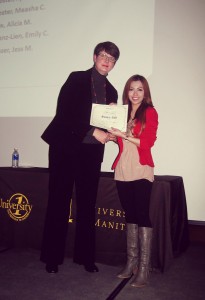
    Coleen receiving a certificate and monetary award during the 2011 Youth Recognition Awards. Photo c/o Coleen Valdez.

    THREE YEARS AGO, Coleen Valdez packed her bags and left for Canada together with her family. At that time, she was a bright-eyed freshman at the University of the Philippines in Diliman. Fast-forward to today, and Coleen is on her third year of studies at University of Manitoba, raking up awards and scholarships for her impressive academic work.

    Eldest in a family of four, Coleen has been surrounded by family members who truly inspire her. “My grandfather was a lawyer working for the Department of Education, and my father is an engineer who, ironically, is passionate and extremely good in writing.” No wonder she became zealous about writing and initially pursued a degree in Journalism. “However, I gradually came to realize that writing is my passion—it’s not an academic pursuit for me.” Due to this, Coleen decided to enroll in the Department of Economics at the U of M which is “a program that I will enjoy and use all my skills, apart from it being very challenging and interesting”, and quoting John Maynard Keynes, “be an all-around scholar”.

    Arriving in Canada prior to the implementation of K-12 program in the Philippines, Coleen had to attend high school again to complete the rest of the credits required to enter university. She attended Sisler High School and her desire to learn never faltered. She received the Margaret and Abe Barg scholarship upon graduating. At that time, she was also in pursuit of other bursaries and scholarships, which led her to become UPAA-MB Inc.’s first bursary recipient. She also received the Outstanding Filipino Students award by the Knights of Rizal Winnipeg chapter for being one of the Filipino/Filipino-Canadian Grade 12 students who graduated with the highest GPAs in the city.

    coleenarticle_02
    Coleen with University 1 Director Dr. Bonnie C. Hallman during the U1 Honour Roll Night. Photo courtesy of Coleen Valdez.

    After her first year in university (U of M calls their general first year university program as University 1 – AS), Coleen has received four scholarships and one bursary including the University Merit Award, which is an award for academic excellence. She also received the Faculty of Arts Special Award, whose recipients were hand-selected by the Dean of the faculty. Moreover, she is a part of the University 1 Honor Roll in her first year and continued to be in the Dean’s Honour List on her second year.

    She mentions that the scholarships and bursaries she has received have helped her in many ways, but sees it to have helped her parents more than herself. Coleen is proud to say that the financial awards she received allowed her parents not to spend anything on her studies. She said she still has a student loan; however, majority of her tuition fee amount have been financed by her scholarship and bursary money.

    Much to her chagrin, Coleen didn’t have much volunteer experience. What little experience she has is with university events such as the Political Studies Student Conference and the annual University Orientation. Schedule conflicts are often the cause – not lack of interest in community work. “I tend to focus on one task at a time,” she says, as she takes a full course load every term and spends the summer working to finance her education. She finds that it is not easy to juggle the academic and extra-curricular tasks based on her experience when she was a student in the Philippines. “I do not recommend students to follow this path; however, I would advise to commit to as many tasks as their schedule and sanity could handle and make sure they can balance all their responsibilities.”

    Coleen plans to volunteer in conjunction with her work once she has finished a portion of her 11-year career plan. “My plans are in the following order: I plan to finish my degree, find work, be involved in the community, and then finish my degree in Law. Afterwards, I plan to continue volunteering in the subsequent years.” She also wishes to be part of an organization like UPAA-MB, Inc. that helps out Filipinos in Canada. Coleen thinks that despite the significant number of Filipinos in Canada, there are still a number of them who still lack moral and financial support in order for them to be successful in the community that they are now a part of. Knowing that there are organizations out there that are able to assist their kababayan is “empowering and motivating.” She also wants be a part of an organization that assists women who are in disadvantageous situations.

    coleenarticle_03
    Coleen with her co-Orientation Leader, Alicia Ling, during the Orientation 2012 at the University of Manitoba. Photo courtesy of Coleen Valdez.

    With her schedule and priorities obviously keeping her busy, how does Coleen handle everything? Coleen said she does pretty well in school and received compliments from her professors; yet, she admits that “she is no Einstein.” She attributes her impressive grades from her curiosity. “I am one of those annoying students who have questions and ask for clarifications all the time.”

    Coleen thinks that asking questions is really important. “There is always 70% chance that half of the class—if not the entire class—has the same question as you have.” She also mentions studying in advance and visiting the professors during office hours as keys to her study habits. “I try to study and do my school works in advance so that I have time to see the professor if there’s anything I don’t get.”

    Asked about tips for incoming post-secondary students, Coleen states that students should admit that they don’t know anything. “It is also important that they commit to as many tasks as they can handle,” but adding that knowing their capabilities is still key in order to complete one assignment without neglecting the other. She also suggests using vacant periods wisely by studying to lessen the work load at home and sitting in front of the class in order to keep up in the lessons. Consulting with university-based support groups is something that students should take advantage of. Coleen cites PEERS at U of M provides confidential support for students who have problems that distract them from performing well at school.

    When it comes to the topic of student finances, she says that scholarships and bursaries are out there, and should they plan to apply, they should be themselves and be confident. “If you think you deserve it, show them why. It is not just the battle of the brainiest; it’s all about who wants to achieve something and who has the passion to do it.”

    Coleen also has advice for Filipino students who have immigrated to Canada and find themselves being required to study again. “Initially you may feel bad, especially if you have to go back to high school in order to meet some Canadian university requirements,” she says. “But that’s totally fine! Make the most of that experience as it’s a great way to meet new people, try new things and most of all, discover yourself.” She provides an example that she didn’t know she does well in Math until she attended Sisler and her teacher and peers noticed that she has the flair for numbers. “The point is,” she says as a closing remark, “going to a different country is an opportunity to discover other things you can do or improve those fields you are already good at. Here in Canada, the only thing that can stop you from dreaming is your own demise. It may be morbid, but it’s true. If there’s a lack of resources to attend school, the government is always willing to help financially to supplement your own initiative to take up a part-time job.”

  • The pathway to being a professional agrologist in Manitoba

    This article features the journey of two Filipino immigrants who studied agriculture at the same university and crossed each other’s paths as they pursued their dream to become Professional Agrologists in Manitoba. It tells about their unique experiences, the challenges and opportunities that came their way and their desire to make a difference in their chosen profession and in their new home province.

    By: Ramon Faustino M. Sales, Jr.


    The past decade has witnessed an increasing influx of immigrants from the Philippines and other countries who have resettled in Manitoba to seek a better quality of life. Many of them are professionals from various fields of expertise. Having a vibrant and fast-evolving agriculture industry, Manitoba offers plentiful opportunities for agrologists (or agriculturists as they are called in the Philippines) and other workers serving in this sector.


    Among these foreign-educated Agrologists, Paulo Fabian and Jennifer Esquibel-Merin had, even before coming to Manitoba, set their sights on building a career in their field of study in their new home province.  However, just like many other new immigrants in Manitoba, both of them were ready to take on transition jobs, while exploring opportunities to practice their profession.


    A native of Sta. Maria, Bulacan, Paulo finished his Bachelor of Science degree in Agriculture, major in Horticulture, in 2002 at the University of the Philippines-Los Banos (UPLB). Prior to migrating to Winnipeg, Manitoba in 2008, he had worked for about four years in the private sector, three years of which dealt with veterinary product sales and landscape nursery establishment.


    In Manitoba, Paulo first attended a pre-employment training program at Employment Solutions for Immigrant Youth, an agency that helps equip the youth with useful tools to find and keep job opportunities. Through this agency, he got a part-time job at a call centre and also obtained information about the agrology profession in Manitoba.


    Jennifer, who hails from Liliw, Laguna, graduated with a  Bachelor of Science degree in Agricultural Economics in 2005 also at  UPLB. She could have opted to build a promising career at the Philippine government’s Department of Agriculture where she worked as a Project Development Officer for over two years, but fate had something else in store for her. Just like Paulo, when she arrived in Winnipeg in 2009, she took on jobs at Staples and Arts and Crafts, while actively seeking to get her credentials assessed and recognized.


    Getting past the first hurdle


    Had it not been for their common desire to practise their profession in Manitoba, Paulo and Jennifer would not have crossed each other’s paths.  They both knew at the outset that the practice of the agrology profession in Manitoba is regulated by the Manitoba Institute of Agrologists (MIA) as enshrined in Manitoba’s Agrology Act.


    Not too long after they submitted their professional certification application, Paulo and Jennifer got their much-awaited response from MIA informing them of their acceptance to a professional program for agrologists. In Manitoba, agrologists are trained and qualified to provide advice to production, processing and marketing of agricultural products, crops and/or livestock.


    As outlined by MIA, the process for Professional Agrologist designation consists of five steps:

    Step 1:  Submission of application form for registration with reference letter from a professional

    and payment of required fees

    Step 2:  Preliminary review of application by MIA. This process includes the review of application

    by the World Education Services (WES) which is based in Ontario.

    Step 3:  Assessment of application by the Admission and Registration Committee (ARC)

    Step 4:  Decision on the application by ARC. If the application is approved, the applicant is then

    registered as Agrologist-In-Training (AIT)

    Step 5:  Fulfillment of requirements to gain full status as Professional Agrologist (P.Ag.) or

    Technical Agrologist (Tech. Ag.)

    (More information can be obtained at this link: http://mia.mb.ca/process_overview.aspx )


    The IEAP Program


    The Internationally-Educated Agrologists Program (IEAP) is a skill-bridging program tailored for foreign –trained agrologists to enable them to integrate into the Manitoba agriculture sector, through a one-year program of coursework and work experience.  It assists new Manitobans with a degree in agriculture in finding relevant work that matches with their skills and experience, while helping Manitoba’s agriculture industry search for new talent.


    Eight-month Course Work


    Under the IEAP program, the participants, who are registered as Agrologists-In –Training (AIT) upon acceptance to the program, are expected to demonstrate and confirm their technical and professional competencies in the Canadian context. The program coursework consists of 8-9 subjects related to the participants’ areas of knowledge and expertise and cover Canadian agricultural business, agricultural science, and production and management practices. The participants are enrolled in courses in the Faculty of Agricultural and Food sciences at the University of Manitoba.


    In addition, participants take up a “Business and Technical Communication” course to enhance their communication and language skills and the “Practising the Profession of Agrology” course to equip them with the know-how about the agriculture industry and the responsibilities of a practising agrologist.

    The IEAP course work runs annually between August and April of the following year. (To obtain more information about the IEA Program, follow this link: http://iep.mia.mb.ca/start-here/the-system/)


    The first five batches of this program benefited from the full funding support provided by the Manitoba Labour and Immigration, which included a monthly allowance for participants during the entire course work.  Program participants came from different countries such as Nigeria, Kenya, Sri Lanka, Eritrea and the Philippines.


    Paulo and Jennifer belonged to the second (2008) and fourth (2010) batches of the program, respectively. Interesting as it was, the program not only allowed the participants to share technical know-how but also to promote meaningful cultural exchanges among them.


    Four-month Cooperative Work Experience


    Upon satisfactory completion of the coursework, the IEAP participants are required to undertake a four-month cooperative (or co-op) work experience to allow them to apply their newly- acquired knowledge and skills in a Manitoba agricultural firm, which many employers look for. The participants have to identify and explore possibilities with any firm for a paid work placement, which takes place from May to August.


    In May 2009, Paulo got placed at the Ian N. Morrison Research Centre in the University of Manitoba in Carman, which he completed in September of that same year. To Paulo, his practicum work proved to be enriching as he honed his skills in conducting interviews with researchers and farmers and from recording field trials of new crop varieties and technologies, including driving a tractor, calibrating equipment, and mixing chemicals, among others. At the end of the co-op work, he put together a written report describing the methods, outcomes and the learning experiences he gained from it.


    For Jennifer, it was a great feeling to have been accepted at MIA to provide human resource assistance to its Admission and Registration Committee in the review and processing of registration applications for the agrology profession. Little did she know that this practicum work would someday serve her well in her present job.


    As they finished the co-op work, Paulo and Jennifer were well on their way to Professional Agrologist status.


    To obtain a full professional status, Agrologists-In-Training need to fulfill additional requirements set by MIA as part of continuing professional development. These include attendance to the MIA annual general meeting and the MIA Professionalism and Ethics seminar. A total of 20 professional credits is needed to meet such requirements, and a whole day seminar is equivalent to 4 credit points. As well, they need to participate in the certification and mentorship process, and pay the required fees. (Additional  information on the requirements can be obtained at this link: http://mia.mb.ca/requirements.aspx)


    Having successfully completed their one-year program in 2009 and 2012, respectively, Paulo and Jennifer had been granted by MIA their license to practice as Professional Agrologists in Manitoba.


    Some Challenges


    Both Paulo and Jennifer consider themselves fortunate, having finished the IEAP program with full financial support from the provincial government.


    Although a modest stipend was provided throughout the coursework, some foreign-trained agrologists are hesitant to take advantage of the opportunity, thinking that it would be a big risk giving up their current jobs.   For Paulo and Jennifer, getting into the program was well worth the risk.


    Getting a 4-month work placement proved to be a challenge for some participants. In Jennifer’s case, it took her two months to find an agricultural company to work with, which caused some delay in completing her program. Getting the right fit between the participant’s area of expertise and interest and the agricultural company’s need was a major consideration.


    Recently, however, some changes have been made to the program. Unlike in the previous years, IEAP incoming program participants will now have to cover their tuition fees and related costs up to $5,500.00, depending on the number of courses. However, they may be referred to potential sources of financial assistance.


    Practising Professional Agrologists


    Shortly after becoming a Professional Agrologist in 2009, Paulo got hired for a six month full-time job as a laboratory technician at the University of Manitoba Soil Science Department. His work involved the weekly collection of soil samples with animal manure that were analyzed to determine their chemical composition and their potential effects on the environment.


    In June 2011, with the assistance of the Career Gateway Program of Manitoba Civil Service Commission, Paulo was employed as a Pesticide Assessment Officer by Manitoba Conservation. His work involved the provision of technical advice and assessment related to pesticide licensing and permits. Eight months later, Paulo got accepted at Manitoba Agriculture, Food and Rural Initiatives (MAFRI) to work as Acting Pesticide and Regulatory Specialist, based in Carman, Manitoba.  This time, he engaged farmers and rural municipalities to educate and train them on pesticides licensing.  As both jobs were term appointments, he juggled his government work with his second job at Air Canada, while seeking to balance work, family and life.


    Jennifer now works half a week at the MAFRI Livestock Section providing administrative assistance and the other half with MIA where she continues to perform the responsibilities assigned to her during her co-op work. An interesting job opportunity came knocking at her door one day, but she had to decline it with a heavy heart as the position was based outside Winnipeg. Had she accepted, she would have been far away from her parents and brother who had recently arrived and joined her in Winnipeg.


    For both of them, getting registered as Professional Agrologists has not only broadened their horizons, but also widened opportunities to meet potential employers looking for their newly-acquired expertise, and expanded their professional network.


    Beyond the IEAP program, Paulo and Jennifer have also shared interests in social-oriented pursuits. As regular members of the University of Philippines Alumni and Associates in Manitoba, Inc. (UPAA-MB, Inc.), they value the strong sense of camaraderie and purpose that binds its members towards improving the welfare of the Filipino community in Manitoba.


    Looking Ahead into the Future


    Paulo, now a doting father to a 2-year old daughter and also expecting a second child soon, and Jennifer, who recently tied the knot, look forward to a stable and fulfilling career in government service.  Both of them though are not closing the doors to the private sector where career development opportunities are equally rewarding. Buoyed by her recent success, Jennifer plans to take up a masteral degree program in the near future, but she is fervently wishing her husband in the Philippines  could join her soon so they could live and build a family together.


    As to their words of advice to aspiring Professional Agrologists, they candidly admitted that hard work, determination, focus and giving one’s best are key ingredients to achieving that goal. The path to a promising future may be long and filled with bumps, twists and turns, but for these two U.P. alumni, getting their full professional status is indeed a big step forward in the right direction.
  • UPAA-MB Participates in the 2012 Manitoba Marathon

    UPAA-MB Participates in the 2012 Manitoba Marathon

    The finish line at the 2012 Manitoba Marathon

    June 17, 2012 – Weeks of training is finally put to the test as UPAA-MB members and family participate in the 34th annual Manitoba Marathon. The annual Father’s Day event’s goal is to raise awareness and raise funds to assist people living with intellectual disability. It is also quickly becoming an annual UPAA-MB tradition, and lines up perfectly with this year’s T-Shirt design contest theme of “active and healthy living.”

    The participants enjoyed perfect running weather and a mosquito-free route as they ran their respective events.

    The following members (and family) participated in this year’s events:

    Full Marathon

    • Norman Garcia
    Half Marathon
    • Lourdes Casañares
    • Jullie Quijano
    • Peter Tan
    10k Run
    • Kristine Acab-David
    • Dennis Flores
    • Jackie Flores
    • Joanna Ocampo-Flores
    • Anna Maniquiz
    • Salvador Maniquiz
    • Bless Ramos
    Mini-Mites
    • Mandy Flores
    Congratulations to all participants. Thanks to everyone who came out to support the runners. See you all next year!
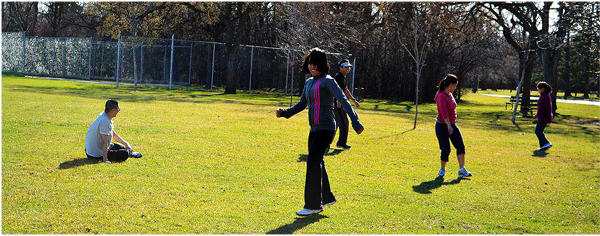
    Cooling down after the race
    UPAA-MB at the Manitoba Marathon. Photo by Jeffrey David.
    UPAA-MB at the post-race lunch


    More marathon photos by Jeffrey David can be found in our gallery.  CLICK HERE


  • UPAA-MB Congratulates Our Registered Architect, Dennis Flores

    UPAA-MB Congratulates Our Registered Architect, Dennis Flores

    UPAA-MB is committed to promoting professional development and educational advancement among our members and our community.  We would like to congratulate our very own Dennis Flores for achieving his professional designation as a Registered Architect and for becoming a Member of Manitoba Association of Architects.
     
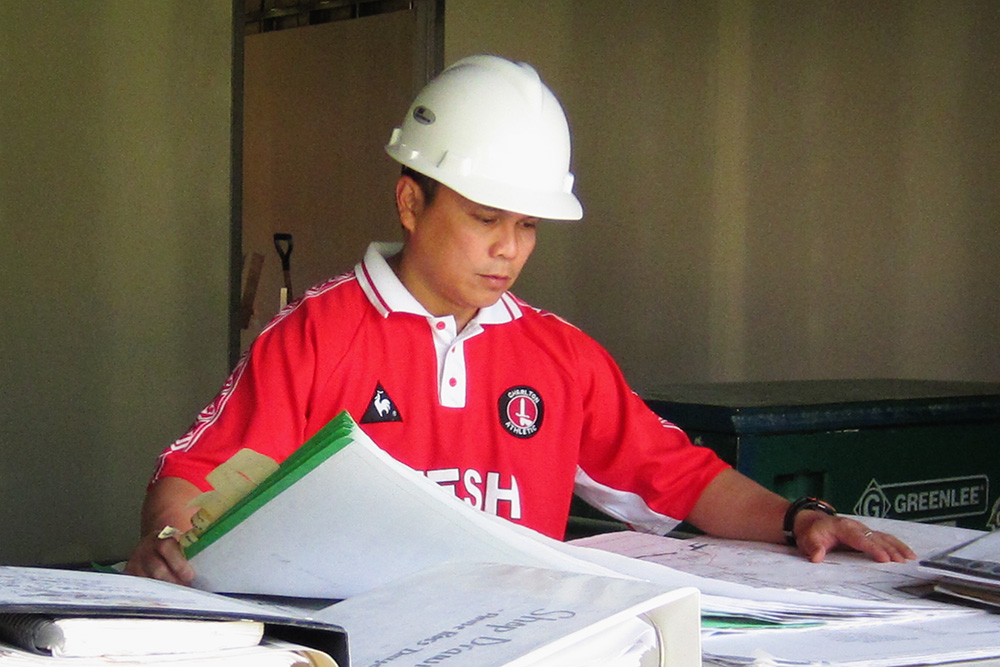
    Dennis Flores with fellow members of Manitoba Association of Architects 2012. Photo courtesy of Winnipeg Free Press.
     
    Dennis has a Bachelor of Science degree in Architecture from the Philippines.  Before migrating to Winnipeg, he has worked around South East Asia and United States.  His experience included working on consultant and client sides of his profession.  At present, he is working on the construction side.
     
                           
                                                                  Our architect at work. Photos courtesy of Daryle Malchuk.
     

     1) When did you arrive in Winnipeg? How was your experience as a new immigrant?

     We arrived in August 2004.  As an optimist and coming from a land, where the people are resilient to adversity, it was easy for me adjusting to a new life in a place unlike home.  Winnipeg in general is a smaller, friendlier, safer and has a slower pace of life than in the Philippines.  The most challenging aspect for me in adjusting was looking for the job that I would really love.

    2) One of the challenges that new immigrants face is getting their first Canadian work experience and reference.  Can you share to us how did you get your first job? And was it related to your Philippine educational background or work experience?

     I remember calling all the architectural firms in the yellow pages and leaving them a voicemail expressing my willingness to work for them pro bono for 2 weeks, just to let them gauge my professional capacity.  I got a call back after 13 hours and got hired the following day.  I am fortunate to land my first job in Canada as an Architectural Technologist.

     3) What made you decide to pursue your professional designation?

     The challenge of getting it and the vision that I can accomplish it.

     4) What are the processes you have to go through in order to become a registered architect?  How long did it take?

     The first step was to get my academic credentials accredited by my profession’s corresponding accreditation body, which is the Canadian Architectural Certification Board (www.cacb.ca).  After getting certified, I had to apply as an intern member with the Manitoba Architects Association (www.mbarchitects.org).  Upon completion of the mandatory hours of experience, I was allowed to write the exams for the Architects Registration (www.exac.ca).

     It took me more than 7 years to become a registered architect.

     5)  What advice would you like to give other Filipino architects, who are planning to migrate to Winnipeg?

     Preparation.  More preparation always leads to better execution.  This is why I always encourage friends to start their career path while they’re still in the Philippines.


  • Running to Celebrate Life

    Running to Celebrate Life

    Fellow iskolars within the organization have been active participants of the Manitoba Marathon for the past couple of summers. This year, UPAA-MB members have gathered and organized ISKO-RUN (an amalgamation of Iskolar and Run and a moniker for keeping the score), which is a running clinic to prepare UPAA-MB members and families for the upcoming Manitoba Marathon this June. The marathon is participated by around 14,000 runners of varying ages, all come together to celebrate life, fitness and family ties.

    Norman Garcia, UPAA-MB’s resident fitness trainer, shares with us his motivation in starting this clinic as well as sharing his advice on how to stay fit, whether you’re a marathon participant or not.

    What is ISKO-RUN and what are the motives behind it?
    ISKO-RUN was established in pursuit of UPAA-MB’s mission to harness the potential of its members and to this end, the Membership Committee aims to prepare interested UPAA-MB members who will be joining this year’s Manitoba Marathon. This is not exclusive to the members though, as their friends and family are also welcome. This is also not just about preparing oneself to run the marathon, but also for those who simply want to get fit or lose weight through running.

    The idea here is to introduce natural running form and techniques to maximize health benefits, to improve physical performance and to reduce the risk of injuries. ISKO-RUN is not just about running—it also includes discussions on nutrition, visualization, strength and cross-training.

    Please describe a usual ISKO-RUN session to us.
    Each ISKO-RUN lasts about 90 minutes, broken down as follows:
    15mins – review of natural running form
    15mins – light jog, warm-up, calisthenics
    45mins – running
    15mins – speed work drills
    15mins – cool-down and stretching
    15mins – discussion on nutrition, strength training, others

    We’ve heard that this training clinic is intense. How do you keep yourself and your “trainees” concentrated and motivated?
    Every session, participants are progressively taking on challenges to slowly build-up their strength and endurance. As the trainer, I encourage each participant to run at the pace that is comfortable to them. I also emphasize that they are not racing against the other participants; rather it’s all about conquering one’s own limit. I think running is a great way to see what you are capable off. Each hurdle, no matter how big it is, can be overcome with proper preparation and visualization. Every time one overcomes a challenge, he or she becomes a better person physically, mentally and emotionally. These changes also bring positive influence to his or her personal and professional life. Running is a spiritual activity as it allows you to discover yourself better.

    I try to keep each ISKO-RUN session fun and interesting by not acting like a drill sergeant. Instead, I work as a running buddy who has also started running at the same level as they have started.


    To anyone who is interested in keeping fit, or joining the MB Marathon, what are your tips/advice?

    – Visualize! Visualize the end in mind. Imagine the following: You’re just a few meters away from the finish line where your family and friends are cheering for you. You’re wearing your favourite clothes. Your health indicators (blood pressure, sugar level, cholesterol level, etc.) make your doctor smile.

    – Be patient. There are no shortcuts. Progressively take on challenges. If you find a drill difficult, regress and slowly build up. Don’t be pressured by what the other runners are doing, everybody started as a beginner.
    – Make sure to warm-up before running and to stretch after running.

    – Run only after 1.5 to 2 hours after a light snack or 2-3 hours after a big meal. Do not run later than 4 hours after a meal as you have less energy. Also eat high protein food within 45 minutes after each workout.
    – Take care of yourself! Invest on a good pair of running shoes and make it a habit to put on sunblock even if it’s cloudy as UV Rays penetrate through clouds.

    – Carry a sports bottle and hydrate yourself regularly; take a sip even if you’re not thirsty; when you are thirsty that’s an indication that you’re already dehydrated.

    – Find running buddies to make running fun, safe and motivating.

    – Be mindful of the surroundings. Appreciate the beauty of the environment especially the trees, flowers, clouds, route, people, etc. Treat each run as “me time” and time to commune with God and nature.

    – After each run, say a brief prayer to our Lord, thank Him for giving you the opportunity to run that day and promise to be a better person after each running session.

    ##########
    Photos by Jeffrey David